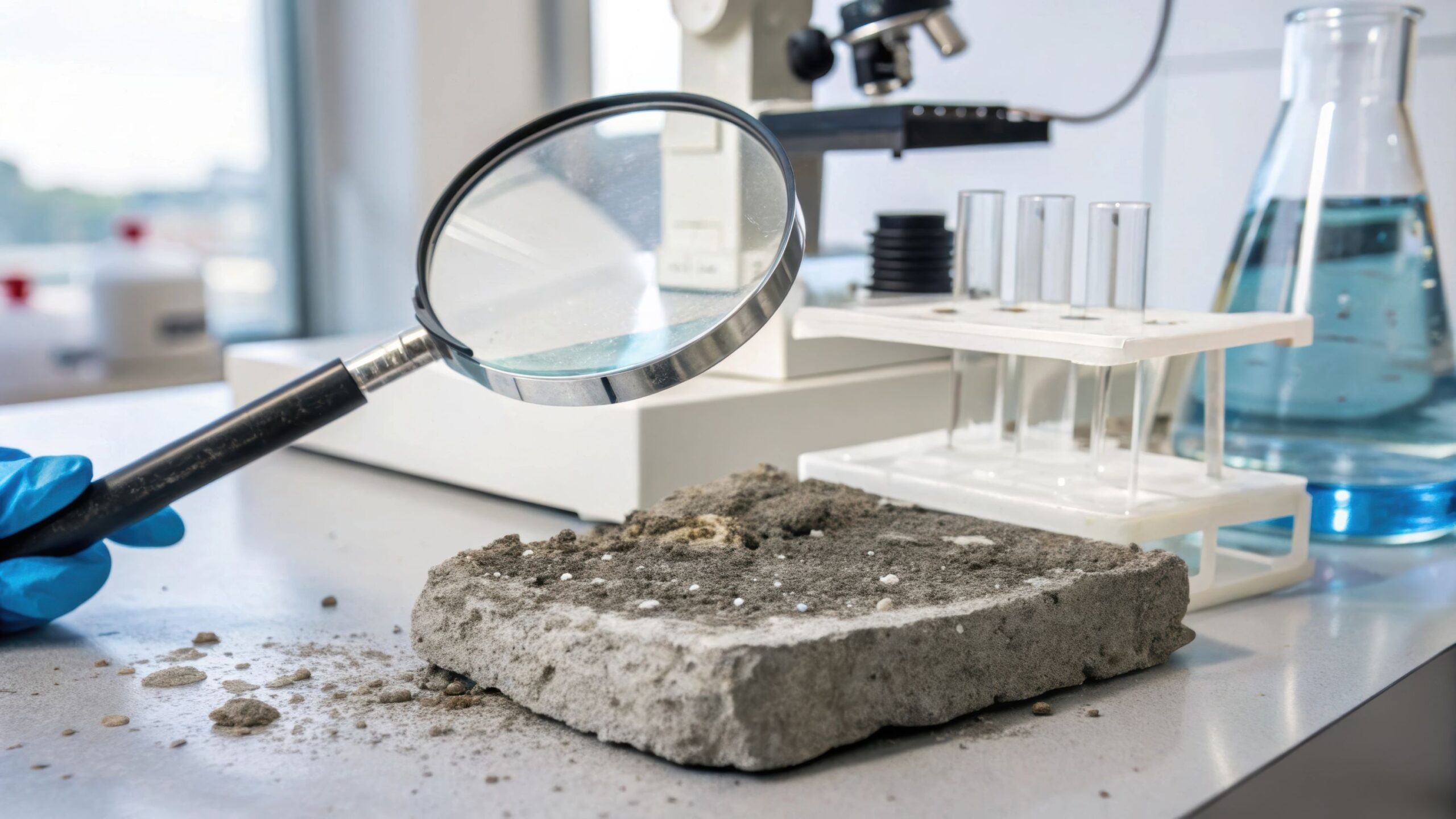
Tapojärvi ja GeoCura kehittävät betonia, joka korjaa itse itsensä
Tapojärvi Innovation Challenge 2025 winner startup GeoCura has developed a groundbreaking concept that uses mining waste as a raw material for a new type of self-healing concrete. Mining waste is one of Finland’s largest industrial side streams, and its utilisation is technically challenging.
GeoCura’s solution sparked strong interest at Tapojärvi, which wants to explore the concept further in close collaboration with the team.
– The idea is intriguing and thematically very close to Tapojärvi’s circular economy thinking, comments Veli-Matti Marttala, Director of Industrial Circular Economy at Tapojärvi.
– Although the solution is still at the idea stage, it shows courage and originality. Incorporating an organic element into concrete production is out-of-the-box thinking at its best, adds Director of Innovation Seppo Ahola.
Mining waste gains a new purpose
GeoCura’s innovation did not emerge by chance, but from a genuine need to reduce mining waste and carbon dioxide emissions in the construction industry.
– Our company was founded during our studies in the AMIR master’s programme, when we were searching for ways to utilise industrial side streams in the production of valuable materials, says Shah Shaud from GeoCura.
CEO Huseyin Cetinkaya had seen firsthand, while working in a mine, how waste accumulates into a serious environmental issue.
– We wanted to turn a problem into a resource – quite literally, he says.
Are bacteria the new workers in construction?
GeoCura’s key insight emerged when the team combined two separate research fields: geopolymer materials and microbiological self-healing.
– We identified a bacterial strain that produces calcium carbonate and thereby seals microscopic cracks, the team explains.
Laboratory tests produced promising results: the material repaired itself and withstood mechanical stress surprisingly well.
– That’s when we realised this was no longer just a laboratory experiment, but a potential breakthrough for the construction industry, Shaud says.
Tapojärvi brings industrial reality to the idea
The collaboration between Tapojärvi and GeoCura demonstrates how research and industry can benefit from one another.
– Veli-Matti Marttala, who acted as Tapojärvi’s mentor, helped us see how the idea could work from a practical waste management and material handling perspective, the GeoCura team explains.
The discussions reshaped thinking around logistics and scalability and brought the laboratory concept closer to industrial application. Tapojärvi, in turn, sees its ECO Innovation Research Center as a platform for further development of the idea.
– First, we need to verify that the concept works in a laboratory environment. Only after that can we talk about piloting, Ahola notes.
If the solution progresses, it could in the future be applied to non-structural concrete products, such as paving stones and slabs.
Circular economy is a mindset
For GeoCura, the circular economy is more than just resource efficiency – it is a way of thinking.
– In nature, everything operates in cycles. One party’s waste is another’s resource. We want to return human activity to that same rhythm, the team summarises.
The company plans to apply for Europe-wide patent protection and aims to begin piloting within five years, preferably in cooperation with Tapojärvi in Finland.
– The most rewarding part of the Innovation Challenge was Tapojärvi’s openness and the discussions that moved us from the laboratory to real-world application. It was inspiring to see how industrial and academic perspectives can support each other in achieving sustainable development, the GeoCura team concludes.
Tapojärvi is particularly interested in seeing how this kind of innovative thinking can be scaled into practical industrial processes.
– This is exactly what Tapojärvi’s circular economy strategy stands for: bold experimentation, collaboration, and responding to real needs, Marttala concludes.