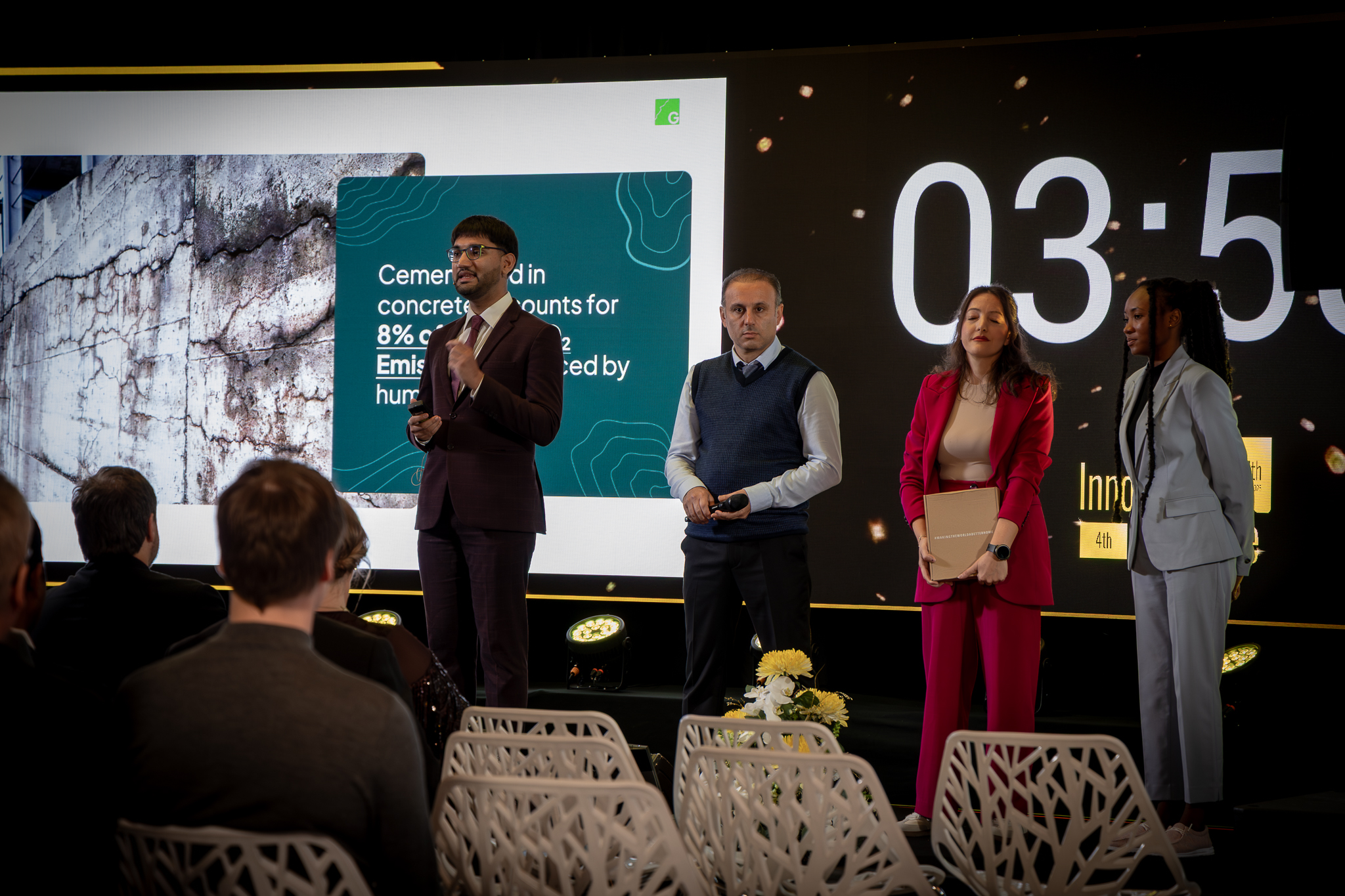
Team RecyGeo finished second, Team Kaabricks third, and Team ECHRO placed fourth but won the public vote and a special €2,000 prize.
Organized by Tapojärvi and EIT RawMaterials, the international competition brought together 37 student teams and 110 students from across Europe to develop solutions for industrial side streams. The final showcased four outstanding ideas proving how waste can be turned into a resource and climate-neutral industry can become reality.
GeoCura: Concrete 2.0 – the new pillar of circular economy
The winning team GeoCura develops a geopolymer-based, self-healing concrete that replaces cement with copper mine tailings and fly ash. The solution can cut CO₂ emissions from concrete production by up to 80% and extend the lifespan of structures. According to the jury, GeoCura combines scientific ambition, business potential, and genuine environmental impact.
“Using bacteria in the concrete industry is a brilliant idea that definitely deserves further exploration. This is a unique innovation,” commented jury member Mauri Kauppi.
RecyGeo: The smart coat for a greener future
Runner-up Team RecyGeo develops a fire-resistant and insulating geopolymer coating made from side streams of the paper and mining industries. The coating provides an eco-friendly alternative to chemical fireproofing materials and helps reduce energy consumption in buildings.
Kaabricks: Sustainable building materials from waste
Third-place Team Kaabricks produces bricks and panels entirely from recycled materials, including textile industry residues and mining by-products. The process requires no cement or firing, making it both energy-efficient and affordable.
ECHRO: Chromium and carbon capture from steel slag
Fourth-place Team ECHRO won the audience award and €2,000. The team develops a process that extracts high-value chromium from stainless steel slag and converts the remaining material into a permanent carbon storage product.
Side streams – the future of industry
Tapojärvi’s Acting CEO Mari Pilventö emphasizes that the competition is a concrete way to advance circular economy through collaboration between students and industry.
“The Innovation Challenge helps us find solutions we might not see ourselves – and it connects young innovators directly with industrial reality,” Pilventö says.
According to Mikko Korhonen from EIT RawMaterials, the competition shows that industrial side streams are the raw materials of the future.
“Europe’s competitiveness will depend on how well we can utilize waste and side streams in new ways. This competition proves that circular economy is the solution,” Korhonen concludes.